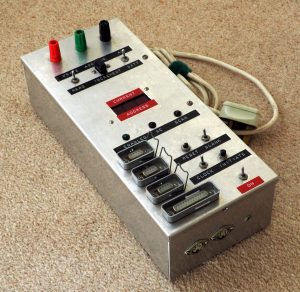
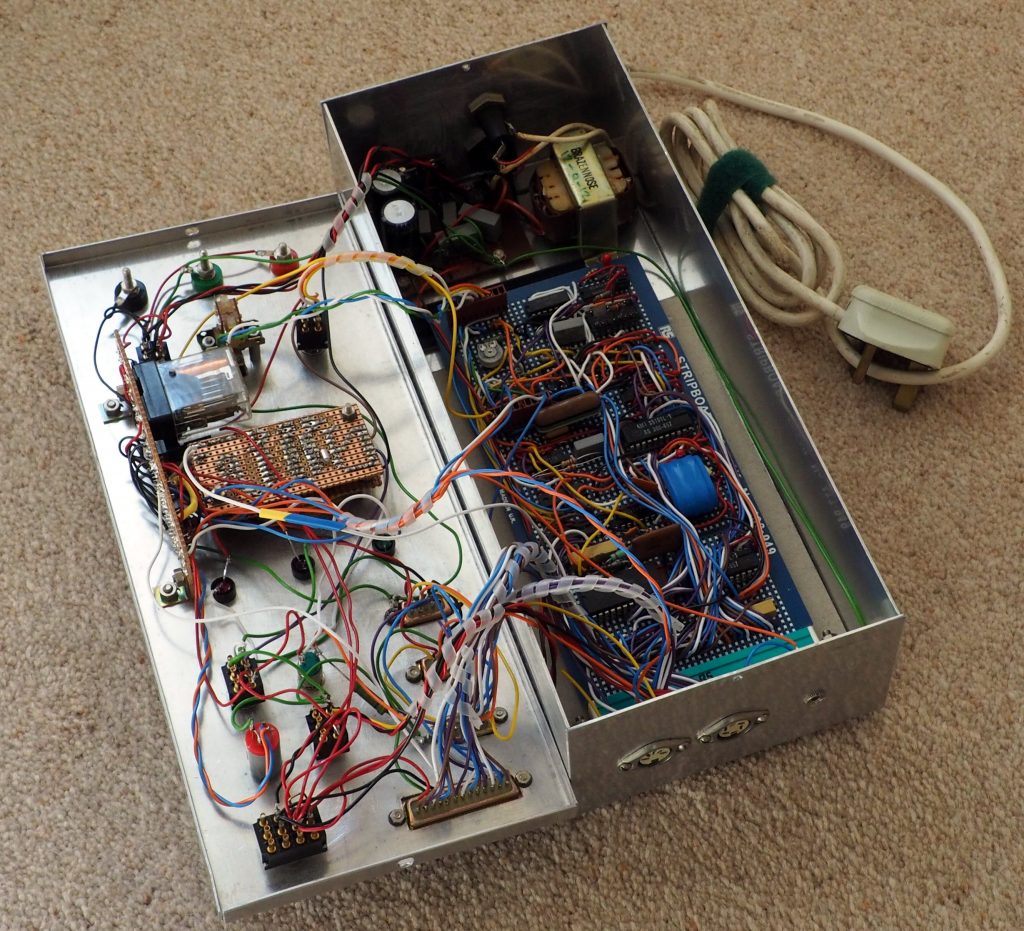
Around 1980 I designed and built a data logger for environmental monitoring. If I remember correctly, it stored eight channels of data at 8-bit resolution. It didn’t have a real-time clock, so accurate timing was problematic, and the user interface was a three digit 7-segment LED display which displayed values in hexadecimal. The prototype worked, but constructing it and debugging it was very time consuming, so the project was abandoned.
The arrival of PIC microcontrollers renewed my interest in DIY data loggers and more recently, the family of Arduino processors made the design and construction of data loggers even easier and cheaper. It is now possible to build an internet-enabled, multi-channel data logger with real-time clock for less that the cost of one of the integrated circuits in my 1980s logger. This means that it’s now feasible to deploy multiple loggers and set-up a dense network of sensors, either to increase the density of sampling or to gather replicated measurements. With this idea in mind I stumbled upon the ‘Cave Pearl’ project set up by Edward Mallon and Patricia Beddows. This on-going project describes the development of a very low-cost data logger for use in a cave environment, which surely must be one of the most challenging for any electronic device. For anyone interested in environmental measurements particularly in a research and teaching context, the Cave Pearl website is very interesting and packed with useful information and links.
Inspired by the Cave Pearl project, in 2015 I set about building one of their data loggers to measure solar radiation, with the idea of building several of these to collect data on the spatial and temporal variability of irradiance in the natural environment. Experimenting with the Cave Pearl design and building several prototypes taught me a lot about the practical aspects of modern data loggers. In particular, it showed how simple modifications could greatly extend battery life, which is always a critical issue in remote or inaccessible locations.
Here are some pictures of the data logger I built to measure solar irradiance based on the Cave Pearl design. Although I have no plans to measure the light level in caves, I adopted the idea of making the unit completely self-contained and sealed against the elements. For this reason I housed the logger in a small weatherproof box fitted with a rubber sealing gasket and included a small sachet of dessicant crystals to mitigate the effects of condensation.
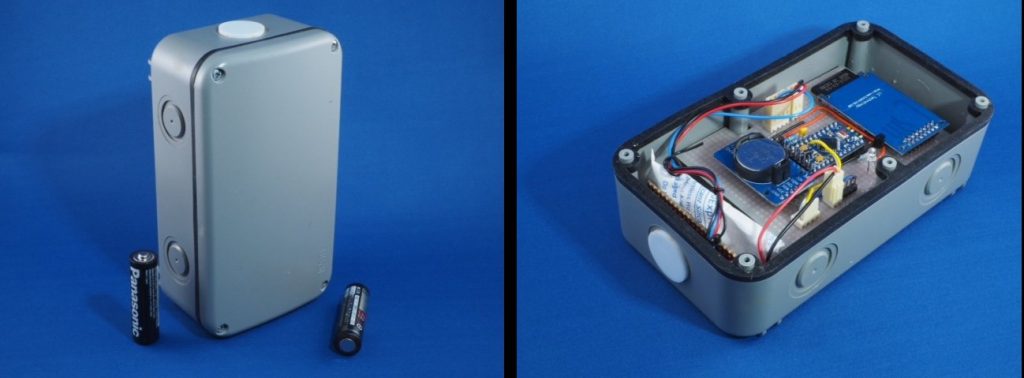
I built the logger circuit on high quality epoxy strip board and after testing the circuit it was protected against the elements with a conformable coating. A 2mm thick teflon disc was glued to the outside of the box to act as a diffuser.
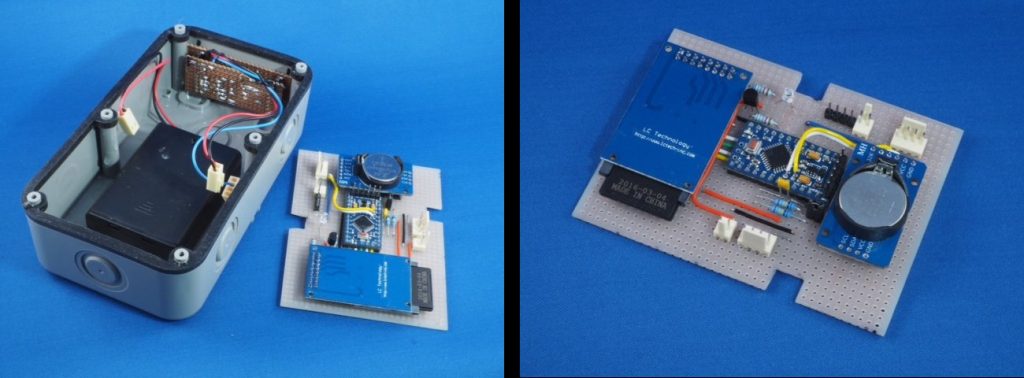
A photodiode was used as the light sensor, operating in short-circuit mode so that it had a linear response to changing light intensity. This was achieved using an operational amplifier configured as a transimpedance amplifier or ‘current-to-voltage converter’:
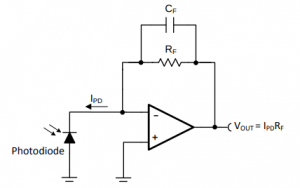
The amplifier and the photodiode were mounted on a small piece of stripboard that slid nicely between two pillars in the box.
Components used in photodiode amplifier
Operational amplifier: Maxim MAX406
Silicon photodiode: Ferranti MS600
RF: 5kΩ variable resistor (set to 1.338kΩ on test)
CF: 47pF